
Railway and Streetcar Tracks
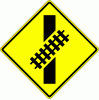
Tracks can cause serious crashes and can also damage your wheels. So treat every set of tracks as a hazard.
How to cross tracks safely
First, plan your crossing early.
Next, slow down and choose a line that lets you cross at a right angle (90°).
Then, shoulder check and signal as needed.
If the tracks sit at an angle, you may need the full lane. So signal clearly and move into position early.
Cross slowly. Also, stand on the pedals if the tracks are rough or bumpy.
After you cross, shoulder check again, signal, and then move back to your normal position.
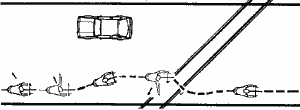
A simple checklist
Shoulder check
Signal
Move into position
Cross at 90°
Shoulder check
Signal
Move back
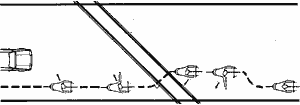
If it feels unsafe
If you cannot cross safely, dismount and walk your bike across. Even at low speed, diagonal tracks can catch a wheel and throw you.
Tracks that run parallel to traffic
When tracks run in the same direction as traffic, lane changes and left turns become much more dangerous. So wait for a safe gap, then cross the tracks at 90°. If traffic is heavy at an intersection and you need to turn left, walk your bike through the crosswalk.
Extra steps for group rides
When riding with OBC, follow these added steps:
Front riders call out the tracks early and use the behind-the-back hand signal.
The group slows down. This matters even when tracks look perpendicular, because the surface near tracks can be broken or uneven.
Riders spread out. This gives everyone space to slow down and cross at a safe angle.
After everyone crosses safely, regroup and then return to normal pace